
How Professional Water Leak Detection Works in Hampshire: What to Expect
- Jun 9, 2025
- 4 min read
A water leak might be small at first, but left alone it can lead to serious damage to your home, sky-high water bills and major disruptions. Although it might not be as common in summer, leaks can obviously happen all year round.

That’s why many property owners across Hampshire, especially in towns like Basingstoke, are turning to professional leak detection services to find the source fast and have it properly fixed.
But what happens when you call in the professionals? If you've never used a team for water leak detections before, here's a full breakdown of what to expect. Our team covers everything, including the techniques, the process, and how it can save you time, money and stress.
Why Professional Leak Detections Are Worth It
Finding a leak yourself is often time-consuming, messy and unreliable. Many leaks are hidden: behind walls, under floors, or buried deep in your pipework. Our professional service uses specialised equipment and training to pinpoint the leak without tearing up your property.
In a county like Hampshire, with its older properties, commercial spaces and new buildings, accuracy is key. A skilled technician can locate the issue without unnecessary damage, and advise on the most efficient fix.
Initial Contact & Assessment
Our process usually begins with a short call or online booking. All you need to do is describe the problem, with common issues including:
A sudden increase in your water bill
Damp patches on ceilings, walls or floors
A musty smell or mould growth
A drop in water pressure
A hissing or dripping sound
Once the basics are gathered, an appointment is booked – often within 24–48 hours, especially for non-emergency issues. If you're in Basingstoke or surrounding Hampshire towns, most local companies aim for a quick response.
The Leak Detection Visit: What Happens On Site
When one of our engineers arrives, they’ll carry out a combination of the following techniques depending on the situation:
Acoustic detection is one of the speediest and most effective ways to find leaks in pressurised systems. It works by ‘listening’ for the sound a leak makes using ultra-sensitive ground microphones and listening sticks.
Water escaping under pressure creates a noise, even if it’s beneath concrete or behind a wall. Our technicians use the equipment to follow the sound gradient and identify the exact location.
This technique is particularly useful in homes in Basingstoke, where buried pipework is common and early detection is key to avoiding damage.
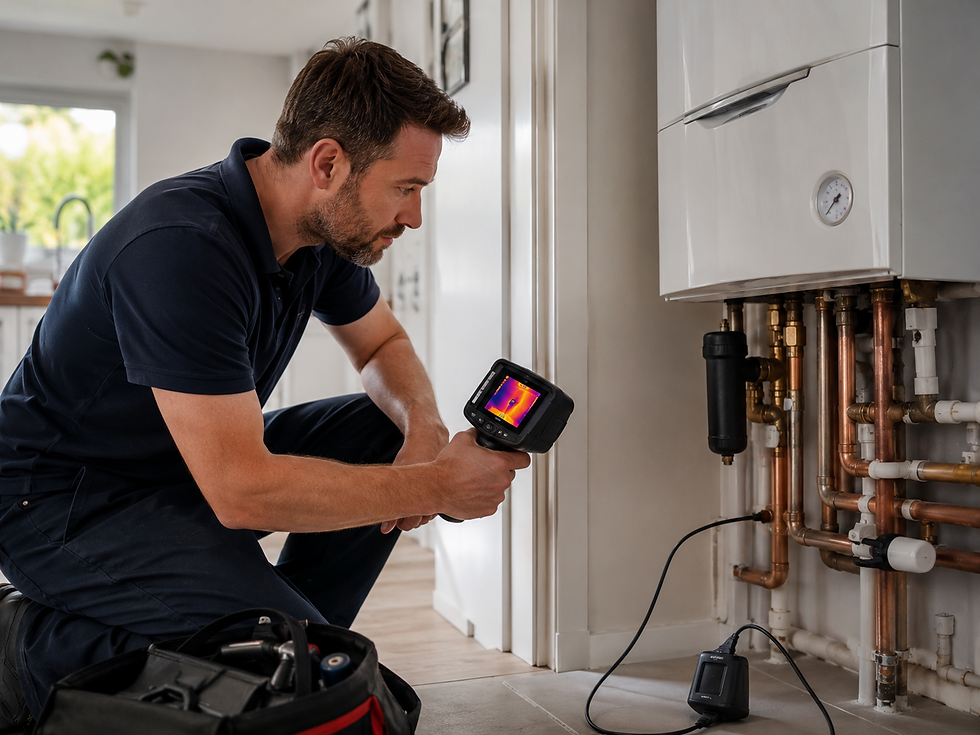
Once you suspect a leak in a particular area, moisture mapping helps confirm how far the water has spread. This is done using thermal imaging cameras, hygrometers and other tools to detect moisture behind surfaces without opening them up.
Thermal imaging cameras show changes in temperature caused by the presence of water. If a cold patch is detected where it ought not to be (such as in a ceiling with no pipework above) it may suggest a leak that’s slowly affecting insulation or timber.
Moisture meters then verify damp levels, which is useful for insurance claims or post-fix restoration work.
If you have a particularly stubborn or inaccessible leak, tracer gas is often the way to go. Here’s how it works:
The water supply is turned off and the system is drained
A non-toxic, odourless gas (usually a mix of hydrogen and nitrogen) is introduced into the pipe system
The gas escapes through the point of the leak
A gas detector “sniffs out” the escaping tracer gas, often through floors, walls, or soil
It’s an extremely sensitive and non-invasive method that allows us to find even the smallest leaks in hidden or underground pipes. In properties in Hampshire with underfloor heating or more complex layouts, tracer gas is a game changer.
Sometimes, the best way to confirm where a leak is located is to isolate sections of the plumbing system and use pressure testing. This involves:
Closing valves to isolate parts of the network (e.g. kitchen vs bathroom circuits)
Pressurising the system to see where pressure drops
Narrowing down which area is losing water
This is particularly useful for commercial buildings or large homes where leaks could occur in more than one zone.
After Detection: What Next?
Once the leak is found, your engineer will provide:
A detailed report with findings
Thermal and moisture images (if relevant)
Recommendations for repair (and a quote if they offer repair services)
If the issue is covered by insurance (which is often the case), having a professional report and documentation is critical to making a successful claim.
How Long Does It Take?
Most visits take between 2–4 hours, depending on the complexity of the issue. Larger buildings or those with challenging leaks often take longer, especially if multiple techniques need to be used.
Whether you’re dealing with an obvious damp patch or a slow, silent drip, our professional water leak detection services in Hampshire can make the difference between a minor repair and major damage to your home.
For more information on our leak detections in Hampshire, don’t hesitate to get in touch today.


Comments